What is LLM advertising?
Robin Lim7 min read
What is LLM advertising?
Short answer: LLM advertising is advertising shown inside products built on large language models, such as AI assistants, chatbots and agents. The ad is matched to what the user is asking in the conversation and usually appears as a labeled sponsored recommendation next to the model's answer. Advertisers pay per impression, click or completed action, and the app showing the ad earns revenue from it.
Key takeaways
- LLM advertising uses the context of a conversation to choose an ad, instead of a search keyword or a cookie profile.
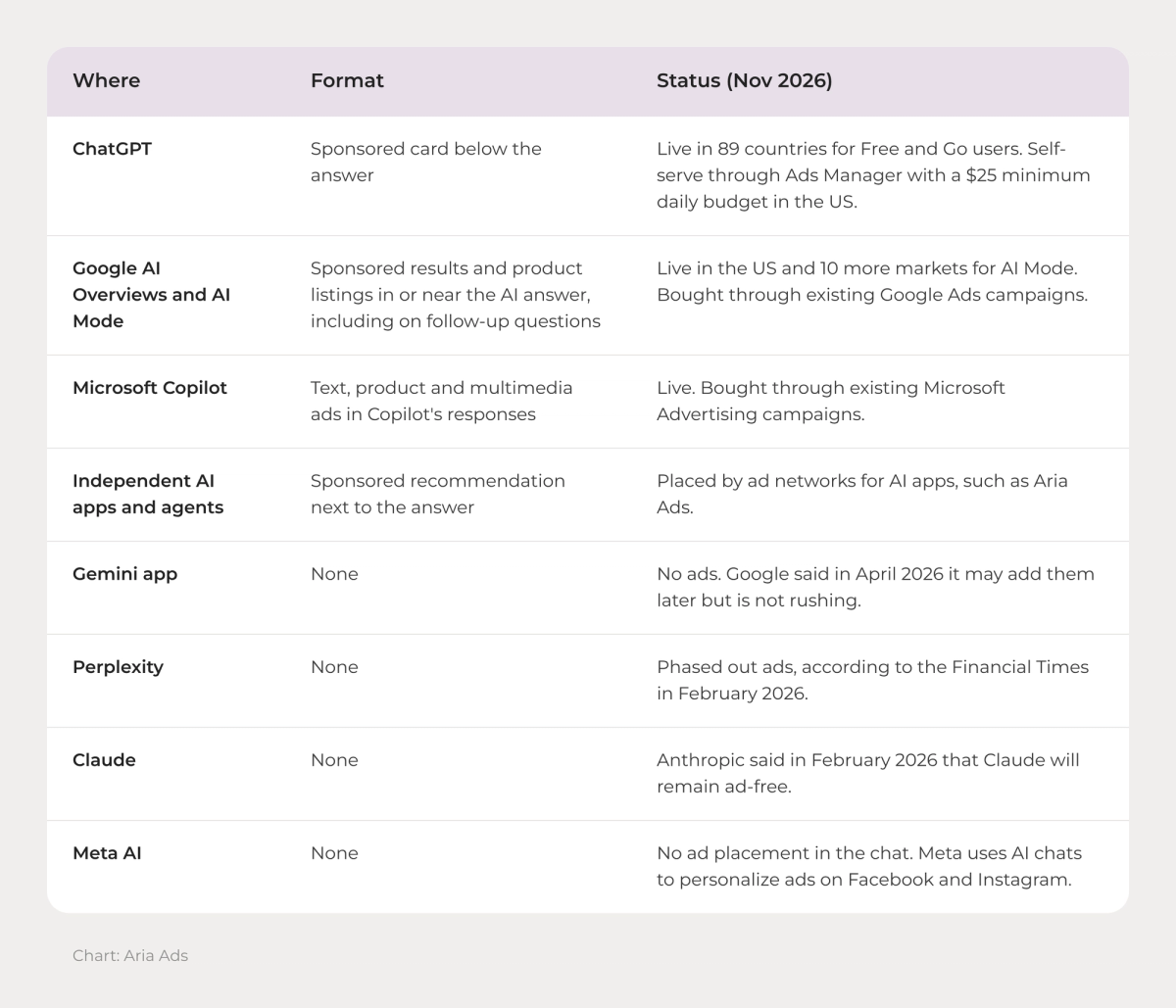
- As of November 2026, ads run in ChatGPT, Google AI Overviews and AI Mode, Microsoft Copilot, and independent AI apps through ad networks for AI apps.
- The Gemini app, Claude, Perplexity and Meta AI do not sell ads inside their chats.
- Most placements show one ad per answer, clearly labeled and kept separate from the answer.
- LLM advertising is paid placement. It is different from generative engine optimization (GEO), which aims to get a brand mentioned in the answer itself.
- The channel is young but growing fast. OpenAI's ad business reached a $1 billion annual run rate within seven months of launch, according to CNBC.
How does LLM advertising work?
- A user asks a question. For example, "What running shoes are good for flat feet under $150?"
- The app sends the context to an ad system. The request runs alongside the model, so the answer is not delayed.
- The ad system checks for intent. It decides whether the question relates to something advertisers sell and which advertiser fits best.
- The model answers on its own. The answer is written without input from advertisers.
- A labeled ad appears next to the answer. The user sees one sponsored recommendation, such as a specific shoe with a price and a link.
- Results are measured. The advertiser pays per impression, click or conversion, and the app earns a share.
The difference from older formats is the signal. Semrush found ChatGPT prompts averaged 8.7 to 13.5 words in early 2026, which is longer than a typical search query. A prompt often states a budget, a use case or a preference, which helps match an ad to what the person actually wants.
How is LLM advertising different from search ads and GEO?
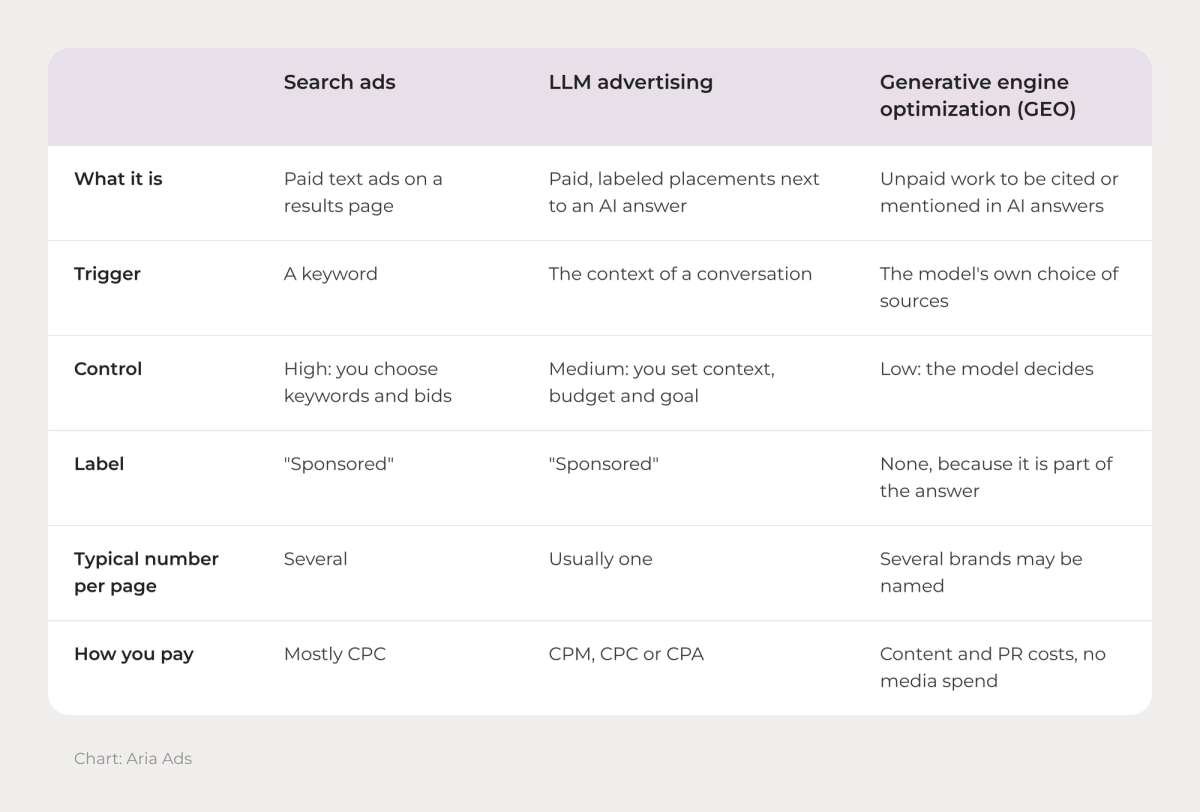
Many brands use both. GEO builds organic presence in AI answers, and LLM advertising guarantees a placement when a relevant question is asked. LLM Pulse found that only 2.8% of ChatGPT ads pointed to a domain the answer itself cited, so the two channels reach people in different ways.
Where does LLM advertising run in 2026?
What does an ad network for AI apps do?
The largest assistants run their own ad systems. Most other AI apps are too small to sell ads to brands one by one. An ad network for AI apps fills that gap. It signs up advertisers, matches each prompt to a relevant brand, serves a labeled recommendation inside the app, and pays the developer a share of advertiser spend.
Aria Ads is an ad network for AI apps. It matches ads to each prompt, labels every placement as sponsored, never shares conversations with advertisers, and lets advertisers buy on CPM, CPC or CPA. For more on how ad networks work in general, see what is an ad network.
How much does LLM advertising cost?
Prices depend on the platform and pricing model. ChatGPT is the only AI assistant with public pricing reports: CPMs of about $25 to $60, and click bids starting at $3 to $5. Google and Microsoft do not report AI placements apart from search. Ad networks for AI apps set their own terms. Aria Ads offers CPM, CPC and CPA pricing with no minimum campaign spend for pilot advertisers. For a full breakdown, see our guide to ChatGPT ads cost and minimums.
Has anyone tried running ads inside AI chatbots?
Yes. OpenAI said more than 100,000 advertisers had run campaigns on ChatGPT by October 2026. Published results so far come from single accounts, and they point in different directions.
- Cheaper leads for some. In one 30-day B2B test, a ChatGPT lead cost $92.21 against $157.57 on Google, even though fewer visitors converted (StubGroup, Nov 2026).
- Strong ecommerce returns for others. One brand spent $9,620 and estimated a 3.3x to 6.8x attributed return (Search Engine Journal, Sep 2026).
- Weak lead quality in B2B. One campaign got 336 clicks from 146 organizations, and only five matched the ideal customer (Search Engine Journal, Sep 2026).
- Lower click rates than search. ChatGPT's average US click rate was 0.73% from March to September 2026, well below typical search rates (Similarweb and Graphite via PPC Land).
The common lesson from advertisers is to judge the channel on conversions, not clicks. Clicks can be cheap and convert poorly, or expensive and convert well. Ads earlier in a conversation also perform better: the first four turns drew 48% higher click rates in Similarweb and Graphite's data.
Are LLM ads labeled, and do they change the answer?
They should be labeled, and they should not change the answer. The US Federal Trade Commission's guidance on native advertising says ads must be clearly identifiable as advertising. ChatGPT labels each ad as sponsored and shows it separately from the answer. OpenAI also says it keeps conversations private from advertisers and that ads do not influence answers. Aria Ads follows the same rules in independent apps: every placement is labeled and kept in a separate card, and advertisers never see what users said. You can read the rules in the Aria Ads trust and disclosure page.
Who should use LLM advertising?
- Brands whose buyers ask for advice before buying. Travel, software, home, wellness, shopping and finance see many "which should I choose" prompts.
- Performance marketers looking for new intent. CPA pricing lets you test without paying for impressions that do not convert.
- Brands that want reach beyond one assistant. ChatGPT ads only reach Free and Go users. Ad networks for AI apps reach people using other assistants and agents.
What does LLM advertising mean for AI app developers?
For developers, LLM advertising is a way to earn from free users without adding a paywall. A developer adds an ad network's API, chooses which categories and brands are allowed, and earns a share of what advertisers spend. Our guide on how to monetize an AI app compares ads with subscriptions and other models.
FAQ
What is LLM advertising in simple terms?
LLM advertising is advertising inside AI chatbots and assistants. When a user asks a question related to something a brand sells, a labeled sponsored recommendation appears next to the AI's answer. The brand pays for the placement and the app earns a share.
Is LLM advertising the same as conversational advertising?
They overlap. Conversational advertising covers any ad delivered inside a conversation, including older click-to-message ads on messaging apps. LLM advertising refers specifically to ads in products built on large language models, such as ChatGPT or an AI shopping assistant.
Is LLM advertising the same as generative engine optimization?
No. LLM advertising is paid and labeled as sponsored. Generative engine optimization is unpaid work to get a brand cited or mentioned inside the AI's answer. Many brands use both.
Which AI chatbots have ads?
As of November 2026, ChatGPT, Google AI Overviews and AI Mode, and Microsoft Copilot sell ads. Independent AI apps show ads through ad networks for AI apps. The Gemini app, Claude, Perplexity and Meta AI do not sell ads in their chats.
How much does advertising in AI chatbots cost?
Reported ChatGPT CPMs run from about $25 to $60, with click bids starting at $3 to $5 and a $25 minimum daily budget in the US. Ad networks for AI apps set their own prices. Aria Ads offers CPM, CPC and CPA with no minimum campaign spend for pilot advertisers.
Do ads in AI chatbots work?
Results vary by advertiser. Some published tests found leads cheaper than Google, and one ecommerce brand estimated a return of up to 6.8x. Others saw low click rates and weak lead quality. Advertisers get the best read by testing with conversion tracking and comparing cost per sale with other channels.