
App monetization strategies for AI apps
Robin Lim8 min read
App monetization strategies for AI apps
Short answer: The strongest app monetization strategy for most AI apps is a hybrid one: a paid plan for the small share of users who will pay, and in-chat ads or affiliate links that earn from everyone else. To make it work, price around your inference cost, choose your paywall on purpose, and raise ad revenue per user by increasing prompts per user, the share of prompts that can carry an ad, fill rate, eCPM and your revenue share.
Key takeaways
- AI apps pay for every prompt, so free users cost money. Each user segment needs a way to cover its own cost.
- Paywall choice is a trade-off. RevenueCat found hard paywalls converted a median 10.7% of downloads by day 35, against 2.1% for freemium apps.
- AI apps earn 41% more per payer than other apps but churn 30% faster (RevenueCat), which makes a hybrid model worth considering.
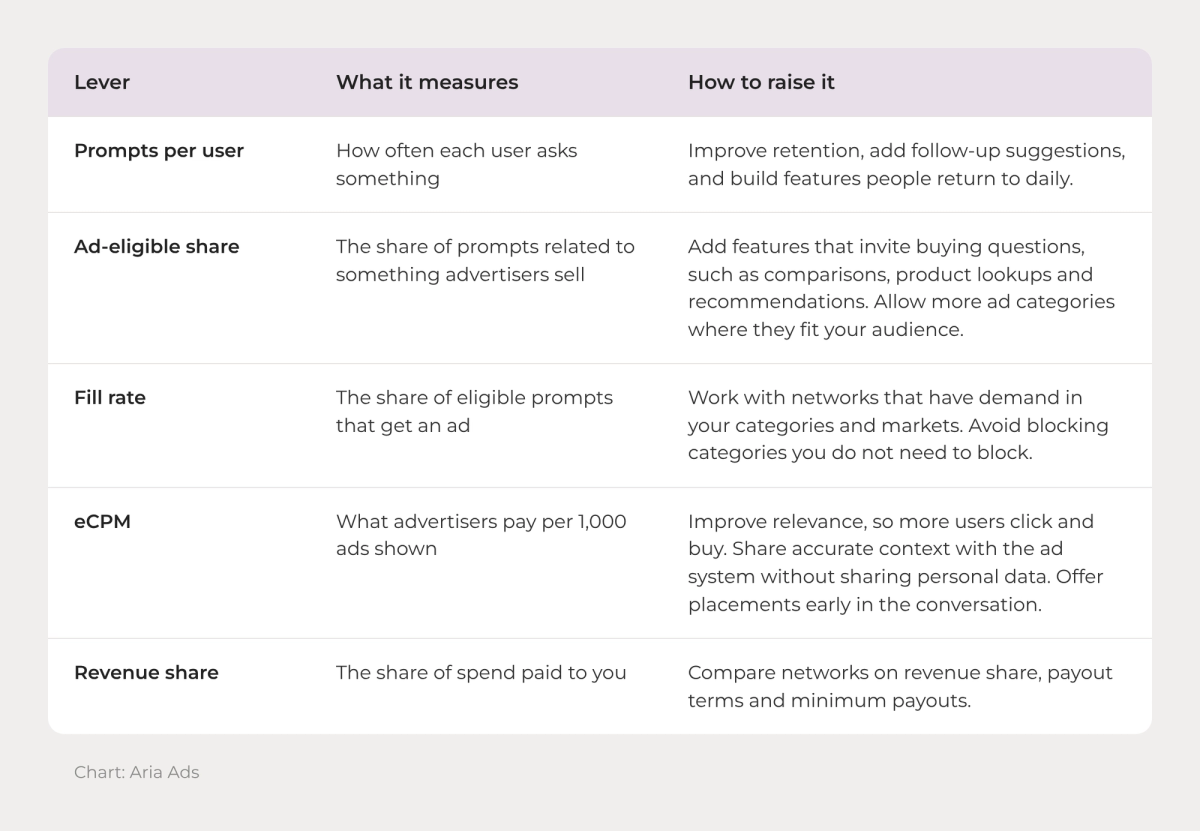
- Ad revenue per user depends on five levers: prompts per user, ad-eligible share, fill rate, eCPM and your revenue share.
- Relevance and placement raise ad revenue more than adding more ads does.
Which app monetization models fit AI apps?
AI apps use the same app monetization models as other apps, but with different economics. For a full comparison of each model, see how to monetize an AI app. In short:
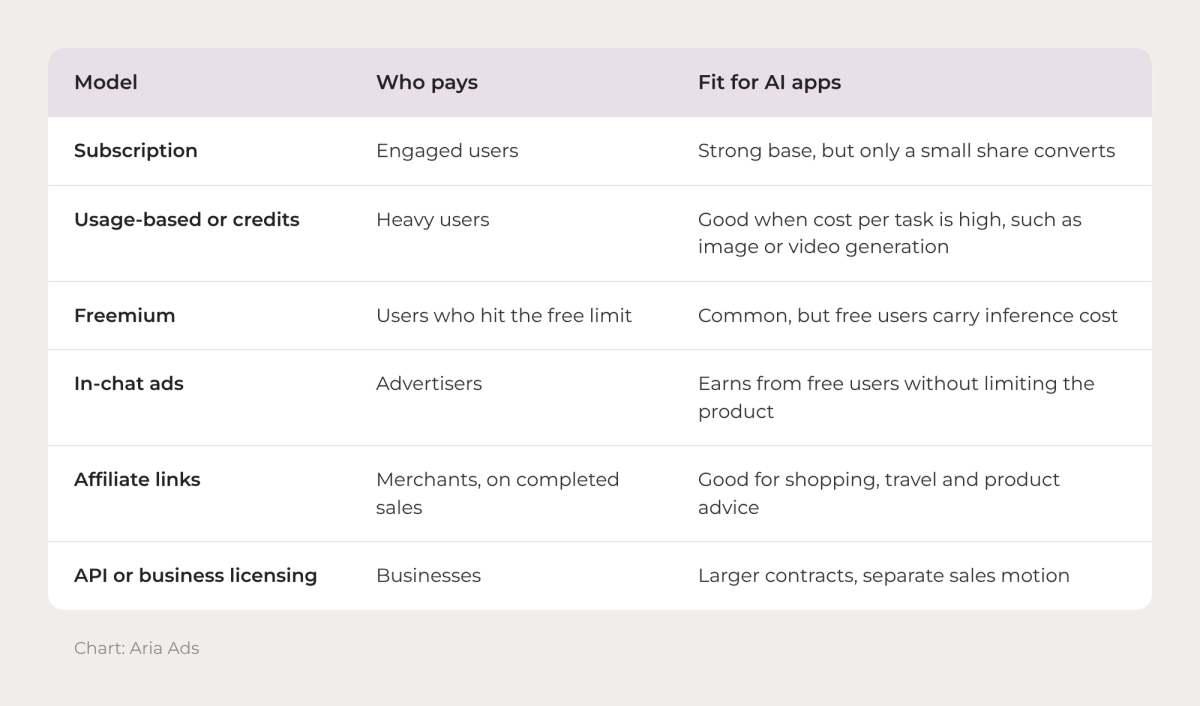
Seven app monetization strategies for AI apps
- Price around inference cost Start with what an average user costs you in model calls each month, for free and paid users separately. Your paid plan should earn well above the cost of a heavy user, and your free tier should have a revenue stream that at least covers the cost of an average free user.
- Choose your paywall on purpose RevenueCat’s 2026 State of Subscription Apps report found hard paywalls converted a median 10.7% of downloads by day 35, against 2.1% for freemium apps, with nearly identical retention after one year. A hard paywall earns more per download. A freemium model keeps the large free audience that word of mouth and ad revenue depend on. Pick based on whether your growth comes from paid acquisition or from free users sharing the app.
- Lead with annual plans and fix retention AI apps earn 41% more revenue per payer than other apps, but their subscribers churn 30% faster (RevenueCat). Annual plans and features that build habits, such as saved history, projects and personalization, help close that retention gap.
- Monetize non-payers with ads Most users of an AI app will never pay. In-chat ads earn from them without a paywall: when a prompt relates to what a brand sells, a labeled sponsored recommendation appears next to the answer. Ad networks for AI apps, such as Aria Ads, handle the advertisers, match ads to each prompt, and pay the developer a share of spend.
- Segment by intent Not every prompt is a good place for an ad. Prompts about products, places and services suit ads and affiliate links. Prompts about writing, coding or personal topics suit subscriptions. Map your top prompt categories and match each to the model that fits it.
- Use limits that teach value Free-tier limits work best when users hit them after they have seen what the app can do. Cap by advanced features or model quality rather than by blocking basic use in the first session.
- Localize pricing In many markets, a US-priced subscription is expensive relative to local incomes. Local pricing for paid plans, plus ads for free users, lets you earn in markets where few people will pay full price.
How do I increase ad revenue per user in my AI app?
Ad revenue per user is the product of five levers:
Monthly ad revenue per user = prompts per user per month × share of prompts that are ad-eligible × fill rate × (eCPM ÷ 1,000) × your revenue share
Improving any one lever raises revenue. Improving several at once compounds.
Placement and format matter
Data from ChatGPT ads shows how much placement affects results. Similarweb and Graphite’s State of ChatGPT Ads report found the first four turns of a conversation drew 48% higher click rates than later turns. Higher click rates mean advertisers bid more, which raises eCPM. Formats with a clear product, price and image also give users more reason to click than plain text.
Protect the user experience
More ads do not always mean more revenue. Showing ads that do not match the question lowers click rates and pushes users away, which cuts prompts per user. In ChatGPT, most answers that carry ads show just one. Keep ads labeled, relevant and limited, and never let them slow the answer.
Illustrative example
These numbers are illustrative, not Aria Ads’ rates. An app has 100,000 monthly users who each send 60 prompts a month. 15% of prompts are ad-eligible, the fill rate is 40% and eCPM is $15. That gives about 360,000 ads and $5,400 a month in gross ad revenue, or $0.054 per user. At a 70% revenue share, the developer earns $3,780 a month, or about $0.038 per user.
If the app adds a product comparison feature that lifts the eligible share to 20%, works with a network that raises fill to 50%, and improves relevance so eCPM rises to $20, ads shown grow to 600,000 and gross revenue to $12,000 a month, or $0.12 per user. At the same 70% share, the developer earns $8,400 a month, or $0.084 per user. That is more than double, without showing more ads per answer.
To estimate your own numbers, use the AI app revenue calculator.
Step by step: building your monetization strategy
- Measure your unit economics. Track inference cost per user, prompts per user per month, and free-to-paid conversion.
- Map your prompts. Group your most common prompts by topic and mark which relate to products and services.
- Set your paywall and plans. Choose a hard paywall or freemium, set free limits, and offer monthly and annual plans.
- Add revenue from free users. Integrate an ad network for AI apps, affiliate links or both, with clear category and brand controls.
- Tune the levers. Each month, review prompts per user, eligible share, fill rate, eCPM and revenue share, and pick one lever to improve.
- Watch retention. Compare retention for users who see ads with those who do not, and adjust frequency if needed.
What mistakes should you avoid?
- Relying on subscriptions alone when most users never pay and each one costs inference.
- Adding more ads per answer instead of improving relevance.
- Blocking broad ad categories by default, which lowers fill rate.
- Letting the ad request slow the answer. Run it in parallel with a timeout.
- Hiding sponsored content or sharing conversations with advertisers.
FAQ
What is the best app monetization strategy for AI apps?
For most consumer AI apps, a hybrid strategy works best: a subscription or usage plan for engaged users, plus in-chat ads or affiliate links for free users. This covers inference cost across the whole user base instead of only the small share who pay.
How do I increase ad revenue per user in my AI app?
Raise prompts per user through better retention, increase the share of prompts that relate to products and services, work with networks that fill more of your inventory, improve relevance so advertisers pay a higher eCPM, and compare networks on revenue share. Placements early in the conversation tend to perform better.
Should my AI app use ads or subscriptions?
Most AI apps benefit from both. Subscriptions earn from the few users who pay. Ads earn from the free majority. Apps with many buying-related prompts and large free audiences get the most from ads.
What is a freemium model?
A freemium model offers a free version of the app with limits and a paid plan that removes them. In AI apps, the free tier usually caps messages, model quality or advanced features. Freemium apps convert a median 2.1% of downloads to paid by day 35, according to RevenueCat.
Do ads hurt retention in AI apps?
Ads that are irrelevant, unlabeled or slow the answer can hurt retention. Ads that are labeled, match the question and appear once per answer are less likely to hurt it. Track retention for users who see ads and adjust frequency if it drops.